Reflections on Being a Math Tutor
Doug Stell · Updated October 4, 2026
To establish a context for my opinions, understanding my background would be helpful. Professional, I was an electronics engineer for 44 years and did analog circuit design, digital logic design, software implementation, and complete systems/product design. During those 44 years, I taught a broad variety of topics nearly continuously. After retiring from my electronics engineering career, the natural thing was to put my many years of teaching experience in the corporate world to work by becoming a one- on-one math tutor in a large, residential institution. For the next 12 years, I worked with children ranging from 3rd grade to collage freshmen, with the vast majority being junior and senior high school math students. This article discusses my feelings on the math being taught or not being taught and how it is being taught in our public school systems.
Many of my students, most of whom are not college-bound, ask me same question. “Why do I have to learn this stuff, when I will never use it?” I always explain that; “Math teaches you to think, logically and orderly. Critical thinking is a skill that you can use in all aspects of life.”
The Role of a Tutor
To a great extent, students just want someone to do their homework for them and make their lives easy. Naturally, there is a great tendency to give into time pressure and “help” a student by doing just that. However, it is necessary to constantly push back against that tendency. The tutor’s job is to enable the student to be self-sufficient and be able to do their own work. I constantly tell students that; “You can not take me into an exam. You must be prepared to pass the exam by yourself.”
The tutor’s job is also to supplement the teacher’s job by explaining clearly material that may not have been covered well in class or the student didn’t really sufficiently understand in class. The next section discusses the difficulties in fulfilling this aspect of the tutoring role.
Textbooks versus Tablets
Partially due to the COVID pandemic and implementing cost-saving measures, the school system where I tutor eliminated all textbooks several years ago and gave students tablets. Some teachers briefly provided their students with hand-outs, from which the students could create mini-textbooks. Most teachers never told students that it is now their responsibility to take notes. The school system did provide on-line tutorials, but they were so poorly and slowly presented that most students refused to use the tutorials. As a tutor, I could no longer determine what a student was being taught or how it was being taught. By flying blind and having, at most, a homework assignment as a hint, the tutor’s job can not be well executed. Overall, the substitution of tablets for textbooks was a major determent to the learning process.
In retrospect, the school should have provided access to on-line .pdf copies of suitable text books, which are available. Fortunately, both the institution and I were able to purchase sets of used textbooks, placed on the used book market by the schools.
Also, as a tutor, I repeatedly asked for a guest log-in to the school’s system, so that I could see what my students were working on. This never happened.
Homework
After eliminating textbooks, the school system where I tutor eliminated all homework. With no homework and no preparation for exams, there is no longer any need for tutors. We simply do not know what, if anything, the students are learning. It appears that they are just being pushed through the system to graduation, only to face the world unprepared. This marked the end of my tutoring.
SINGAPORE Math
Educators and most other fields, tend to be like lemmings, all racing off the same cliff. When my kids were small, they taught “guesstimation,” so as to not clutter young minds with facts, especially the multiplication tables. While they pretended that children could do calculus in second grade, it was a total disaster, with parents and eventually teachers rebelling against it. Singapore math, in my opinion, is another such trend.
In the lower grades, math is taught using techniques that might be good for visual learners, growing up with video games. The core belief is that a symbol such as “5” is too abstract for a child to comprehend. If you are talking about five stars, it should be expressed as “* * * * *” or five fingers on you hand.
However, these math techniques may teach concepts, but are useless for numbers of any reasonable size. As a result and as a math tutor, we have had to reteach basic, conventional math, starting in about the 4th grade. This already puts students behind by starting their math education at such a later age. Most students never recover and are still behind when graduating from high school. Colleges are reporting that new freshman students require remedial math to learn what they should have learned in high school. The same is true in other academic subjects, such as reading and English.
Personal Finance
The school system where I tutor requires all high school seniors take Personal Finance, instead of a higher math class. This is good for students that are not college bound. The math is relatively easy, with table-based loan calculations being he most difficult topic. A topic might be analyzing the cost of taking loan and buying a car now, versus saving any buying the car later with cash. Another topic is figuring out how much you have to spend on housing and what size apartment you can afford in your community. Fiscal responsibility is a good thing that many adults have never learned or have learned the hard way. Unfortunately, it detracts from the math education of college-bound students.
Impact of Artificial Intelligence (AI) on Math Education
All my former students know how to get AI to do their homework assignments for them, with no effort or the possibility of learning anything. While they get their homework done, they are much more likely to fail in-class quizzes and tests. AI can even learn a student’s handwriting and generate output that doesn’t have to be copied over by the student. Colleges are now reporting that the failure rate among college algebra students has risen significantly, from around 20% to 50%, due to the same use of AI.
A possible and likely solution is to have them do the homework in class, where they can’t use AI. However, this significantly cuts into instructional time. Another solution would be to make homework count less and administer more frequent in-class quizzes and have students come forward in class and actually demonstrate how to do a problem.
Many school districts have blocked or are considering blocking Internet access and/or the use of smart phones in schools. This would prevent the use of AI during tests and for doing in-class homework. The school district where I tutored is currently considering such action and it is very controversial, with most parents arguing against the action.
Along the same lines as AI, I had a student who was very good in math. She cut a deal with the other students, where she would do all their math and they would do all her other subject’s homework. Everybody was getting their homework done, until test time revealed the truth.
As further suggestions for teachers, use AI to solve the homework you give your students. This may enable you to spot submitted assignments that were done with AI. Also, compare submitted assignments from multiple students. If they are too similar, these students may be using AI.
School Funding
The school system where I tutored is critically and chronically underfunded. As a result, the school facilities are in serious disrepair and they have a difficulty attracting and retaining good, qualified teachers. I admire dedicated teachers, who faithfully teach regardless of compensation. Unfortunately, I have worked under very good, young teachers, who cannot provide for their families and are forced to leave the state as soon as they have their full credentials. I have seen schools offer to hire unqualified people as teachers, in order to fill vacancies. One year, a school suddenly lost their Algebra 2 teacher and simply had the French teacher take over Algebra 2, which did not work well at all.
Alternate Number Systems
The remainder of this article discusses mathematics topics that are useful in the modern age of computers and for people entering any form of computer science, including software and electronics engineering, but are not taught in the school systems. Students today still learn only the same math that I learned in the late 1950's and early 1960's, just a lot less of it. Therefore, they are less prepared in math today for technical fields than I was before the age of computers.
Humans all know and use decimal numbers, only because we have ten fingers. While decimal may be good for humans, it is not natural or useful for computers, which are binary devices. Therefore, this section will discuss numbers systems that are useful for computers and form a good compromise for both humans and computers. With the possible exception of binary, and octal, the other number systems should at least be introduced to students, although only computer scientists and related fields need to be comfortable using these systems.
Decimal Number System
Decimal uses a number system where each digit can have ten possible values, because we have 10 fingers. These values are listed as '0123456789.' The next value after '9' is '10.' Nothing new here.
In this section, we will use the decimal number '987654321' and demonstrate it's values in other number systems.
Binary Number System
Internally, computers use binary bits, where each bit has only two values, 0 or 1. Therefore, the decimal number above, '987654321' would be represented as '0011101011011110100010110001.' Reading from right to left, this would be 1+16+32+128… While very computer friendly, binary is not human friendly at all.
Hexadecimal Number System
As a compromise, hexadecimal uses a number system where each digit can have 16 possible values, as opposed to only 10 values of the decimal system. These values are listed as '0123456789abcdef.' The next value after 'f' is '10'. It is read as “one zero' and is equivalent to the decimal value 16. Note that the values represented by the letters 'a' through 'f' may be either upper or lower case.
The binary number above is partitioned into groups of four bits each, and each group is assigned its corresponding hexadecimal value, as follows. The '0x' prefix is simply a way of stating the the value is hexadecimal format. The '0x' is not part of the value and serves only as an indicator of “hexadecimal.”
'0011 1010 1101 1110 0110 1000 1011 0001'' is then expressed as '0x3ade68b1'
Note that hexadecimal numbers are more compact and have less digits than their counterparts in other number systems. This makes them very human friendly, especially with dealing with very large values. As an electronics engineer and mathematical cryptographer, I have probably done more math in hexadecimal than I have in decimal, which may seem surprising. As a cryptographer, I typically worked with numbers in the range of 900 hexadecimal digits or about 1,200 decimal digits in length.
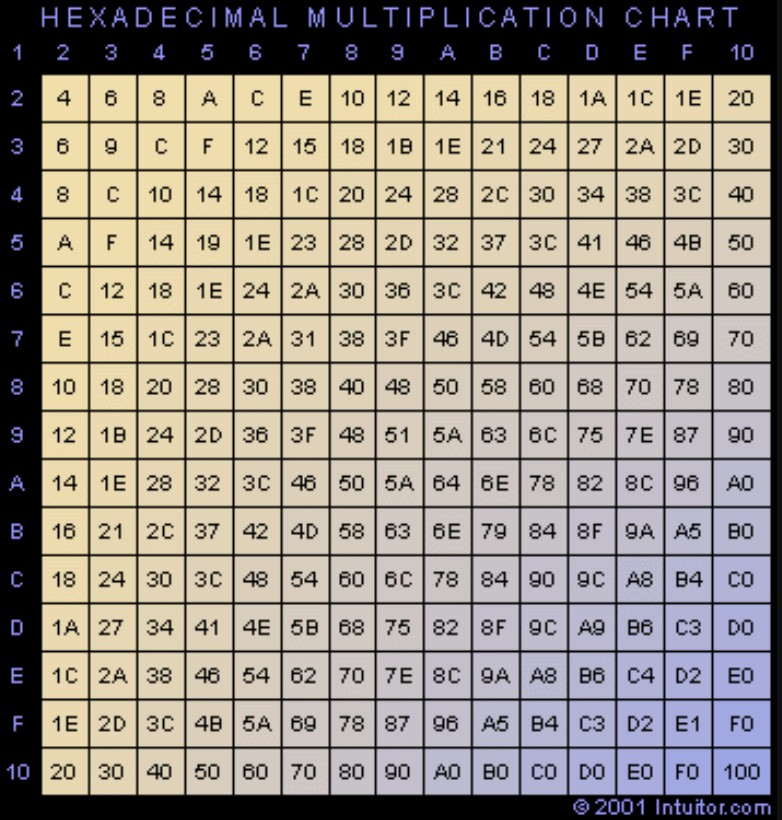
A hexadecimal multiplication table is included as an appendix to this paper. The hexadecimal value of '100' in the lower right of the table is equivalent to the decimal value 256.
Octal Number System
While no longer used in the era of modern computers, the octal number system is included here for completeness.
As an early compromise, octal uses a number system where each digit can have only eight possible values, as opposed to the 10 values of the decimal system. These values are listed as '01234567.' The next value after '7' is '10'. It is read as “one zero' and is equivalent to the decimal value 8.
The binary number above is partitioned into groups of three bits each, and each group is assigned its corresponding octal value, as follows. The '0o' prefix is simply a way of stating the the value is in octal format. The '0o' is not part of the value and serves only as an indicator of “octal.”
'111 010 110 111 100 110 100 010 110 001' then expressed as '0o7267464261'
Boolean Algebra
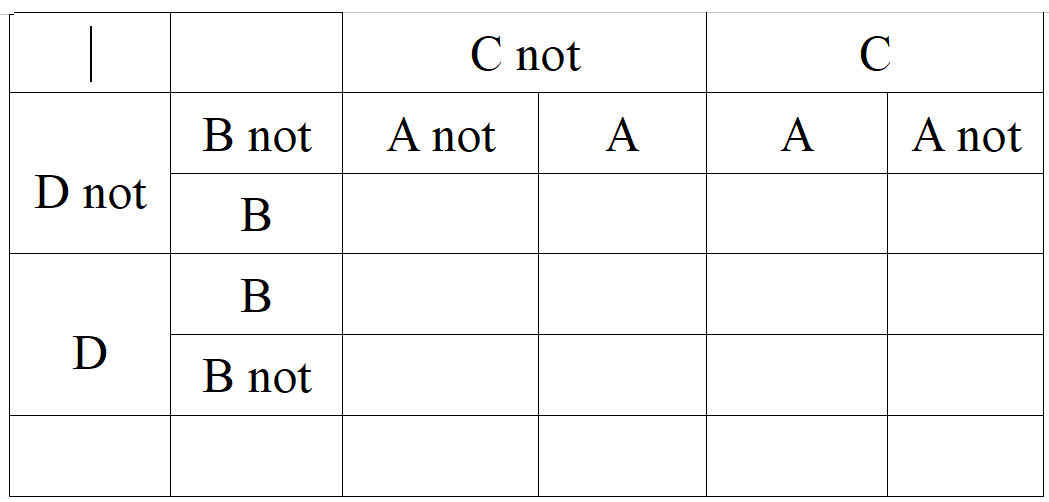
George Boole was an English mathematician and logician who, in 1847, invented the algebra used in all logic and digital electronic circuit design. High school algebra already introduces students to 'set theory,' with concepts such as 'union' and 'intersection.' It would be a simple extension of this topic to include logic theory with the same concepts, called 'or' and 'and' plus 'exclusive-or.' There are simple graphical tools, such as 'Karnaugh Maps' for translating logic problems into Boolean equation.
As an electronics engineer, designing numerous digital logic systems, I have probably done as much Boolean algebra in my career as conventional algebra and always always had a stack of blank Karnaugh Maps on my desk.
Appendix
Hexadecimal Multiplication Table
Four-Variable Karnaugh Map Example