
Canals & Tunnels of Niagara Falls
This article was written after watching a YouTube video on the tunnels of Niagara Falls. That video was interesting, but misleading and incomplete. Therefore, this article attempts to complete and accurate. Since most of the tunnels and canals are associated with hydro-power generating plants, the topic is covered as these facilities exist along the Niagara River. Any tunnels and canals not associated with power plants are covered at the end of this article.
The difference between a tunnel and a conduit is simple. A tunnel is excavated entirely below ground. A conduit is built by excavating down from the surface, placing a water-carrying structure down into the excavation, and then restoring the land above the conduit
John Dean Adams Power Plant (U.S.):
Located about 1.5 miles up-river from the falls, this power plant was funded by George Westinghouse and designed by Nicola Tesla, Charles Proteus Steinmetz, Thomas Evershed, and several other notable engineers of the time. It the first of the three “deep pit” power plant designs in the area. In this design, the generators were at the level of the upper Niagara River and the turbines were located at the bottom of a deep pit. The turbines and generators were connected by a long shaft.
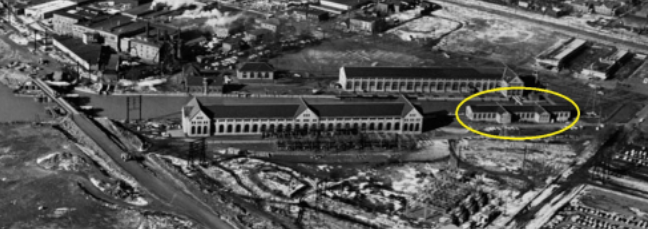
Intake canal:
As can be seen in the photo above, this power plant had a 250 ft wide and 12 ft deep hydro canal that supplied water from the upper Niagara River to Power House #1 and Power House #2, which were located on opposite sides of the canal. Each Power House had 10 generators, supplied by the canal. The canal was mostly filled in when the State built the Robert Moses Parkway along the river. Only a small section of the canal exists today. The two Power Houses were razed in the mid 1960’s.
The Transformer House had no source of water and, therefore, contained no generators, contrary to some erroneous sources. The Transformer House still exists and was later intended to house a museum, which never materialized. Located at 1501 Buffalo Avenue, it is now used as a warehouse for winter
storage of boats and RVs.
Discharge tunnel:
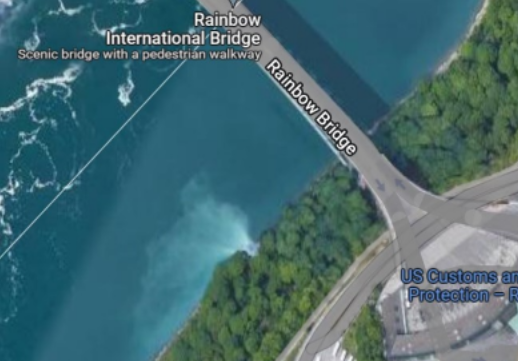
The 7,000 ft long, brick lined discharge tunnel ran from below the wheel pit of the Power Houses to the lower Niagara River, between the Maid of the Mist boat landing and the foot of the Rainbow bridge. It was the 80 feet of elevation lost to the slope of this tunnel that made Adams very inefficient, leading to its closure in 1924 (not 1961 as erroneously stated in many documents). In 1924 Adam’s water
allocation was transferred to the newly constructed and more efficient Schoellkopf 3-C facility.
Since the mid 1980s, the tunnel is repurposed for the effluent discharge from the city’s waste water treatment plant, built on the property adjacent to the Adams Power Plant.
Toronto Power (Canada):
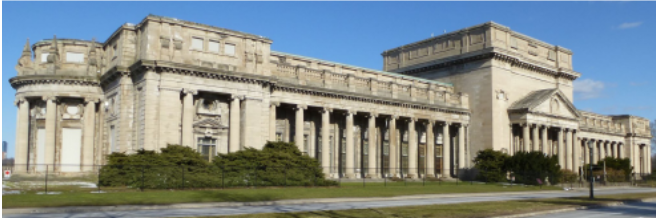
This magnificent building was built in the early 1900s. Its beautiful architecture was chosen, because it was built within the park, not far from the main tourist area. It is one of the three “deep pit” power plant designs in the area.
Intake canal or tunnel:
None. This power plant sat on the shore of the upper Niagara River and took water directly from the river without the need for a canal or tunnel.
Discharge tunnel:
This power plant had a discharge tunnel to that went from below the wheel pit to the lower Niagara River, behind the Horseshoe Falls. The tunnel is inaccessible, except from the bottom of the facility. The tunnel was built using concrete rings, so that rings would break off as the Horseshoe Falls erodes.
Rankin Station (Canada):
This attractive building was built in the early 1900s with the first generators coming on line in 1905. Its architecture was chosen, because it was built within the park, in the main tourist area, near the brink of the Horseshoe Falls. Now a museum, it is the last remaining example the three “deep pit” power plant designs in the area.